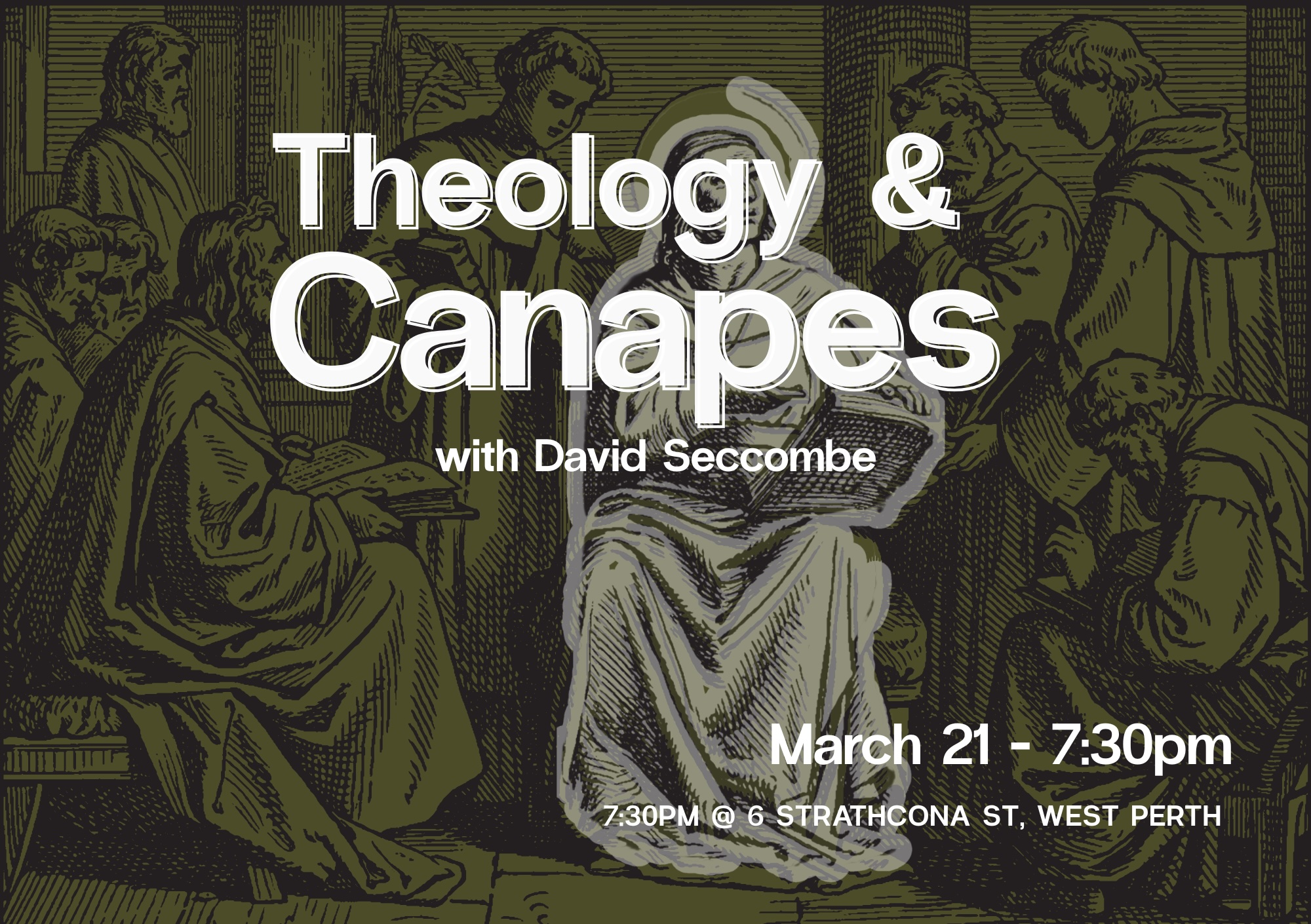
An EFAC Evening at Nigel and Carolyn Armstrong’s Home 21 March 2026
I came away from three years of research into Jesus’ teaching about wealth and poverty with a fascination for Jesus’ earthly ministry and also for the writings of Luke. In 1977 Hans Conzelmann, a German New Testament professor, put out the idea that Luke wrote his two books to answer a crisis which he believed occurred towards the latter end of the first century A.D. brought about by Jesus not returning in that generation.[1] Before Conzelmann wrote, Luke was widely seen as a scissors and paste editor of early traditions about Jesus. After Conzelmann he became seen as a theologian in his own right, putting forward in the Gospel and Acts his own distinctive message.
The “holy grail” of Luke studies is to know the purpose for which Luke wrote his two-volume masterpiece. There are different levels of purpose, and possibly multiple purposes, so in this talk I intend just to focus on the question how Luke intended his two books to be used. I think that if we used them as was originally intended we would be greatly helped.
In contrast to Conzelmann, Howard Marshall (1970), in his study of Luke-Acts identifies “salvation” as the main theme, and evangelism as the purpose. Robert Maddox (1982) disagreed, on the grounds that the amount of attention given to Paul’s trials “dampens the impression of an evangelistic purpose.” He thinks the double work is to help Christians understand their true identity, over against Jewish denials.[2] In a paper I gave at a conference at Stellenbosch University in 2003 I took issue with this and backed Marshall, chiefly on the grounds that ten presentations of the gospel in Acts mean Luke wanted people to hear the gospel over and over. Luke’s Gospel itself is, as its name implies, the gospel writ large.
Evangelistic Addresses in Acts
- The Pentecost Address (Acts 2)
- Address at Beautiful Gate (Acts 3)
- Peter answers the High Priest (Acts 4)
- Stephen addresses the Sanhedrin (Acts 7)
- Peter speaks to Cornelius (Acts 10)
- Paul’s sermon in Pisidian Antioch (Acts 13)
- Paul speaks to pagans in Lystra (Acts 14)
- Paul addresses the Areopagus Court (Acts 17)
- Paul addresses King Agrippa (Acts 26)
- Paul’s appeal to the Jewish leaders in Rome (Acts 28)
As a result of a postgraduate class at GWC I moderated this view, and began moving towards the position I now hold.
I begin by reading the passage I think could be the major clue. We need to remind ourselves that the speeches in Acts are the main vehicle for Luke to present his appeal. His narrative of what happened does not interpret itself; Luke does not inject his own interpretive comments into his account, and relies largely on Jesus, angels, prophets, and apostles to provide meaning (theology). The author has command of what material he presents and what he omits, and will determine the amount of detail he includes according to his overall purpose. Note the amount of detail on the Christian ministry in this address.
Now from Miletus he [Paul] sent to Ephesus and called the elders of the church to come to him. And when they came to him, he said to them: “You yourselves know how I lived among you the whole time from the first day that I set foot in Asia, 19serving the Lord with all humility and with tears and with trials that happened to me through the plots of the Jews; how I did not shrink from declaring to you anything that was profitable, and teaching you in public and from house to house, testifying both to Jews and to Greeks of repentance toward God and of faith in our Lord Jesus Christ. And now, behold, I am going to Jerusalem, constrained by the Spirit, not knowing what will happen to me there, except that the Holy Spirit testifies to me in every city that imprisonment and afflictions await me. But I do not account my life of any value nor as precious to myself, if only I may finish my course and the ministry that I received from the Lord Jesus, to testify to the gospel of the grace of God. And now, behold, I know that none of you among whom I have gone about proclaiming the kingdom will see my face again. Therefore I testify to you this day that I am innocent of the blood of all, for I did not shrink from declaring to you the whole counsel of God. Pay careful attention to yourselves and to all the flock, in which the Holy Spirit has made you overseers, to care for the church of God, which he obtained with his own blood. I know that after my departure fierce wolves will come in among you, not sparing the flock; and from among your own selves will arise men speaking twisted things, to draw away the disciples after them. Therefore be alert, remembering that for three years I did not cease night or day to admonish every one with tears. And now I commend you to God and to the word of his grace, which is able to build you up and to give you the inheritance among all those who are sanctified. I coveted no one’s silver or gold or apparel. You yourselves know that these hands ministered to my necessities and to those who were with me. In all things I have shown you that by working hard in this way we must help the weak and remember the words of the Lord Jesus, how he himself said, ‘It is more blessed to give than to receive.’” Acts 20.17–35 (ESV)
The purpose of the gospel speeches is plain enough, but what is this exposition of the Christian ministry doing in an evangelistic work written for outsiders? That was our question. It is fairly obvious that the very full record Luke gives of Paul’s account of his ministry—Luke was present to hear this speech—is intended as a model for pastors in Luke’s own time.
The suggestion arose that as an exercise we regard this as the key to Luke’s intended use of Acts and see how the rest of the book (and the Gospel) fit. In other words, how well does the content of his two books accord with the suggestion that they are an instruction or resource for church leaders? We found that most of Luke and Acts fell into place on this suggestion.
To see that this is so, it is helpful to think for a moment about Theophilus. Luke addresses him as “Your Excellency,” the same title he gives to the Roman procurator, Felix. This tells us Theophilus was a man of rank. We know he was a Christian, because Luke would never have entrusted his precious manuscript to someone who was not. That Acts is addressed to the same person tells us the first volume was favourably received.
What was expected of Theophilus? Luke would hope that Theophilus as a man of wealth would see to the books’ publication, but before that, he would discharge his responsibility as a patron by having the books read aloud initially in his own home. Most people did not read, and would never be able to afford a book such as Luke has written for private reading; they would hear them read aloud. Such meeting were popular entertainment in the first-century. At once, we see the usefulness of the multiple gospel presentations in Acts; Luke wanted all who heard to be confronted with the gospel over and over.
If Theophilus also saw to the copying of Luke’s manuscripts, to whom would they go? When Paul’s missionary party were ejected from Philippi, Luke remained behind possibly to pastor the new church, possibly to help the churches that spread into Macedonia.[3] One need only reflect on what materials were at his disposal for this task—the Old Testament and Mark—to understand his wish firstly to add more material about Jesus, and second to answer the questions he addresses in Acts. He had opportunity to do both when he accompanied Paul to Jerusalem, and was nearby when Paul spent two years in Roman custody in Caesarea, a one-day walk to Galilee, two-days to Jerusalem, and three to Jericho.[4] The most likely first recipients of copies of Luke, and then Acts, I would suggest—it is only a suggestion—were pastors of churches in Macedonia and Greece, or would have been had not Nero’s attack on Christians in Rome have made both books dangerous items to have in one’s possession.
Let us consider the contents of Luke and then Acts with the scenario I have sketched in mind.
Luke, like all the Gospels, addresses the question who is Jesus, and answers with clarity that he is Israel’s promised Messiah and more. He also says much about his mission (to establish the kingdom of God and bring salvation to all mankind). In addition, he provides a portrait of Jesus: not just who he is, but what he was like. These are central gospel concerns. In addition, however, almost half his Gospel consists of Jesus’ teaching on this and that, and instruction on what we call discipleship. This could add to a presentation of the gospel, but makes more sense in a resource-book for Christian teachers. There are also passages that could be special instruction for pastors on their own role.[5] Peter’s question to Jesus about whether his parable of the waiting servants was for them (the apostles) or for all, and Jesus’ open-ended answer,[6]looks this way. So does Luke Sermon on the Mount.[7]
Coming to Acts, we find that the question of Jesus’ identity and mission is prominent, though there is nothing like a portrait, since this is covered in the Gospel. As we have seen, most of the speeches serve an evangelistic purpose. Acts also deals with four pressing questions: the identity of the church (is it a sect as the Jews say, or a work of God’s Holy Spirit), the admission of Gentiles, the necessity or otherwise of circumcision for Gentiles entering the churches, and the faithfulness of Paul (hence Christianity) to Israel’s election and Scriptures. These four are important questions to be answered by evangelists, as well as by pastors in their normal defence of Christianity. The last major instruction for Christian pastors, bespeaks more than an evangelistic motive.
How finally might we make best use of Luke and Acts if what I have argued is close to reality? The first thing to suggest is that we arrange readings of both books in a comfortable venue both for our own people, and wherever we can find an audience. Both Luke and Acts are intended as evangelistic tools. A skilled reader will be necessary if people are to “hear” what they are hearing.
An alternative to this suggestion is what I heard of a group of inquirers in London who met and read the Gospel of Luke with a minister, without interruption, until someone said they had a question. When the question was dealt with, the reading continued, for as many sessions as it took. At the end most of the group had become Christians.
Second, considering the Gospel passage by passage is what we are mostly accustomed to, and was no doubt the main use to which first and second-century teachers and preachers put it. Some think Mark constructed his Gospel of gobbits (pericopes) because these were familiar to him as preaching units. In one way or another the Gospels should be central to our instruction of God’s people. Jesus is portrayed as Lord and Christ, his mission is the kingdom, entry into the kingdom is crucial, and just as important is it that we learn the life of the kingdom, and know we are learning it from the Lord. Of course, all of the Scriptures are instruction in Christian living, but it is important that we not inadvertently divorce them from Jesus himself, and equally important that we not neglect his actual teaching.
A third way we might employ both books is in different thematic series. Luke’s Gospel deals with the questions, who is Jesus, what was he like, what was his mission, what is a disciple, what is the Christian life, and how did his mission end? The issues of Acts are: Who is Jesus? How did Christianity begin (the Holy Spirit)? What is the church? How did a Jewish movement become world-wide? Should Christians observe the Jewish law? Did Paul corrupt Jesus’ teaching?
Finally, pastors should apply themselves intentionally in study to Luke and Acts as handbooks written for them. Who knows what treasures may emerge.
[1] Die Mitte der Zeit. English translation: The Theology of St Luke (1982).
[2] Xxx The Purpose of Luke-Acts ()
[3] Acts 16.
[4] Acts 21.1–18; 1.19–27.1.
[5] Luke 6.27–49.
[6] Luke 12.35–48.
[7] Luke 6.