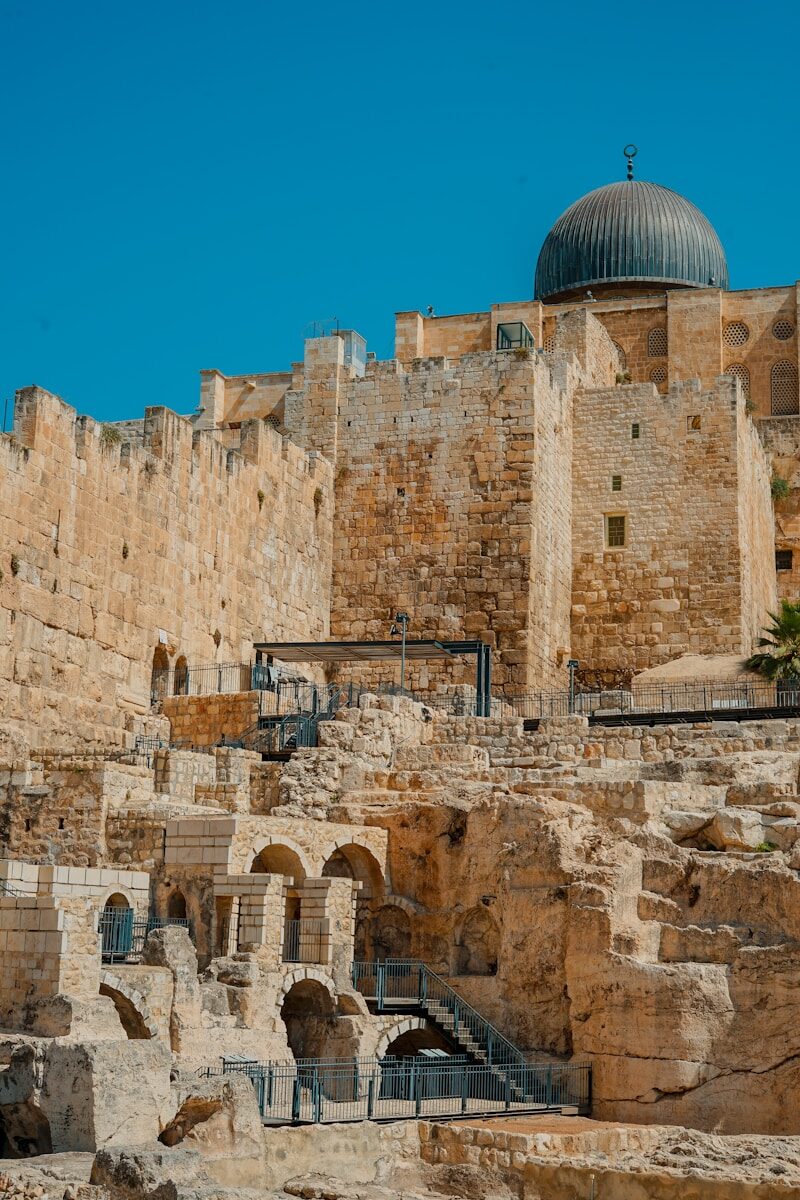
Genesis 12.1–9
A sermon preached at Lockridge Anglican Church 19th April 2026
I’m thinking of getting a tourist party together and hope you might join it. We will start at Fremantle or Kwinana and take a ship—maybe a returning oil tanker—and we will head for the Straits of Hormuz. We’ll need to sweet talk the Americans and Iranians to let us through, then continue up to the top of the Persian Gulf, and make some enquiries at Basra. I imagine it would be best to continue in a smaller boat north along the Euphrates to Nasiriyah—we would be in Iraq—and now I’m a bit lost. Google didn’t help me, nor any of my atlases, but I’m sure the locals could point out the way to the ancient city of Ur, and there we would find ourselves in the ruins of the one-time home of Abraham. 4000 years ago it was a major city of the Sumerian Empire.
If you then have the time, we could join a walking tour, and follow Terah and his family northwards along the Euphrates about 800 kms, to the old city of Haran in modern-day Turkiye. There the family decided it had had enough travelling, and settled down. I guess you could reach an airport somewhere near and fly home. It would be a great trip, don’t you think?
It would be even better if we could have gone back in time and caught up with the family just after father Terah died, and Abram was considering what to do now. It would be interesting because the decision he was about to make would change the course of world history. It would bring us to where we are today, even that big airbase we passed in Nasiriyah.
I thought we could talk about Abraham today, because he is the father of Jews, Arabs, and Christians, and is presumably to blame in some way for what is going on at the moment.
Genesis 12.1 Now the LORD had said to Abram, “Go from your country and your kindred and your father’s house to the land that I will show you …”
The New Testament says God called Abram in Ur, where the people worshipped the Moon god. He was told to leave his friends and relations; Terah, Sarai, and Lot went along, but dug their heels in at Haran. But now Abram is free to move again. God has called him to journey to a land he would show him. He set out not knowing where that would be. Such a strange command!
But God is God. He made us. When he commands you obey—or you rebel, and that is trouble. I read the story of Abraham when I was a new Christian all of 18 years old, and it touched me. Perhaps I connected to the idea of journeying into the unknown. I had struggled with something I believed God wanted me to do—or not to do, actually—and when I gave in, I had the sense I was no longer in control of my own life—that I was starting a journey into I didn’t know where. Many times through my life I have looked to Abraham as a model; life is a trek into the unknown.
When God commands, you either obey or you rebel, and that takes you into uncharted territory.
God also made Abraham a promise, a promise of blessing.
Now the LORD said to Abram, “Go from your country and your kindred and your father’s house to the land that I will show you. And I will make of you a great nation, and I will bless you and make your name great, so that you will be a blessing. I will bless those who bless you, and him who dishonours you I will curse, and in you all the families of the earth shall be blessed.”
Note that the word “blessing” is used five times; that’s what this story is all about. To understand its importance we must go back to the beginning of Genesis where God made the world, and blessed our original ancestors. What do we mean by blessing?
A couple asked me to marry them. They were both doctors and told me they were atheists. They assured me they were not looking for a traditional church to be married in, but had investigated and felt a Christian service gave their marriage more meaning. I pointed out that if there was no God, nothing had meaning. Surprisingly, they agreed, but added that they wanted their marriage to be blessed, and only a Christian service did that. They wanted things to be good for them, to be happy, and to have a good future. And that is what God promised Adam and Eve: they would increase, be happy, and have a good future —but as you know, things quickly turned to worms. They refused to obey God, and although he didn’t curse them, he put them and their environment under the curse of death. As we read on in Genesis, we learn what the world without God’s blessing looks like: envy, murder, revenge, and slave kingdoms.
But now God promises Abram blessing—Abram was his original name— but notice who is to receive this blessing: all the families of the earth are to share in the blessing, so long as they remain connected to Abraham. If they don’t they remain under the curse.
I shouldn’t have to tell you what a huge thing this was and is. The blessing that was lost in the Fall, is to be restored through Abraham and his family. Can you also see that this promise effectively divides the world in two. There is the family of Abram and those who are blessed through him, and the others. I found when I caved in to God’s command and didn’t do what I wanted, that I too was given a promise, a promise of eternal life. I had no idea at the time that I had become connected to the very promise God had made Abraham. But this is jumping forward a long way; we need to ask what the blessing was that Abraham was promised.
“You will be a great nation,” God tells him, and as the story moves on various things are added. When they reach Canaan in their travels—the land we call Palestine—God promises Abram that this land will belong to him and his descendants. His wife is barren so are faced with not having descendants, but God promises them a son. So eager are they to make this promise come true that Sarai gives her handmaid to Abraham to produce a surrogate child, but that’s not what God meant, so Sarah also bore Abraham a son. Isaac and Ishmael become the fathers respectively of the Jews and the Arabs. Both are in some way included in the blessing.
A great nation, a land, a promised son—a miracle child—descendants as the stars in the sky, kings, but most important, friendship with God: “You will be my people, and I will be your God.” We must never lose sight of that, because if we do, we miss what this is all about. Our ancestors fell away from God, and now God is working to restore the lost relationship. If we refuse to know God, we cease to have anything to do with the promised blessing.
So Abram went, as the LORD had told him, and Lot went with him. Abram was seventy-five years old when he departed from Haran. And Abram took Sarai his wife, and Lot his brother’s son, and all their possessions that they had gathered, and the people that they had acquired in Haran, and they set out to go to the land of Canaan. When they came to the land of Canaan, Abram passed through the land to the place at Shechem, to the oak of Moreh. At that time the Canaanites were in the land. Then the LORD appeared to Abram and said, “To your offspring I will give this land.” So he built there an altar to the LORD, who had appeared to him.
Abram obeyed, he went, and when he reached Shechem (modern day Nablus), God spoke to him and promised that this was the land that would belong to him and his children. Genesis is quick to point out that the land was not terra nullius, not without inhabitants. There was an advanced culture of city-states each with its king. Abram was a nomad, who wandered the open country between the cities, with his family, servants, donkeys, cattle and goats. He owned not a stitch of land, but God promised it would all one day be his. What a thing! If God made the world, and he promises you a share of it, you as good as hold the title-deeds in your hand. That is why he builds an altar. It is a memorial of the promise that has just been made, as well as his worship of God. He doesn’t want anyone in his family to forget, especially not the children and grandchildren who will follow. We should register here that this Bible we hold in our hand, and which we read Sunday by Sunday is the memorial of what God has done and said and promised. We don’t have to go back searching for piles of stones; it is all recorded for us here. God help us if we ever forget!
From there he moved to the hill country on the east of Bethel and pitched his tent, with Bethel on the west and Ai on the east. [This is not far from where, 1000 years later, David and Goliath will have their famous battle.] And there he built an altar to the LORD and called upon the name of the LORD. And Abram journeyed on, still going toward the Negeb.
Abram’s family has now travelled through the land from north to south, marking it with altars along the way.
What are we to make of it? Perhaps we should ask first how God worked it out. This takes us on a 2000-year journey with Abraham’s family: Jacob aka Israel, Moses, Joshua, David, Solomon, Elijah, Isaiah, Daniel, Ezra and many others, a story of triumphs and tragedies, but overall of descent, of falling from God, and a failure to find the blessing.
And then came a visitor, a man named Jesus who said he had come from God to bring ultimate blessing to Israel and the world, just as God had promised. He called this blessing the kingdom of God. His coming was controversial. It led to a fork in the road. There were those who believed that he came from Abraham’s God and those who thought he was an imposter. So, the world is split into believers and unbelievers. Fast forward 600 years and an Arab, Muhammad, claims to have received messages from the God of Abraham. They are different to what Jesus taught; Muhammad said God wanted his kingdom to be established by war. Many people believed him, so the road forked yet again. There are now those who follow the Jewish rabbis, those who follow Jesus, and those who follow Muhammad, and all claim to be heirs of the promises made to Abraham. It’s messy I know, but you have to figure out which way is correct, if you are to escape the curse, and find the blessing.
It may seem too complicated to be bothered, but to sit on the fence is not possible; fence-sitters remain with the world that is perishing. Jesus’ follower Peter was questioned by a Jewish court a few weeks after Jesus’ death and resurrection. This is what he said: ”There is salvation in no one else [than Jesus], for there is no other name under heaven given among men by which we must be saved.”[1]
You may find this too exclusive to be believed, but think about it: You may have a certain kind of cancer, and there is only one treatment. Will you refuse the treatment, because it is available in Australia, but not in Africa? Our present culture demands inclusiveness, but this is fantasy.
Consider something else: Jesus lived a life that no one has ever faulted. He did many miracles. He said he would be killed, but God would raise him up. He was killed, and God didraise him. Muhammad died and was buried; Jesus is alive.
Consider this too: Jesus predicted the destruction of the Jewish temple, and that Jerusalem would be trodden down by the Gentiles until the times of the Gentiles should be fulfilled . Forty years afterwards, the temple was destroyed, and Jerusalem was in Gentile hands for the next 2000 years.
Consider too that Jesus foretold that the word of his kingship—for he said that God had appointed him ruler of the universe—would be taken to the ends of the earth. And it has. And he said that only then would the final end come. And it hasn’t yet.
I accept that there is a lot of filling in to do between Abraham and Jesus—it is all here in the Bible. And between Jesus and today we have the Acts of the Apostles, and the last 2000 years of history is pretty well recorded. There is no excuse for us who live in a land with a Christian heritage for not investigating.
I mustn’t end without referring to the wars in Gaza, Israel, and Iran. They are part of one great struggle. Muslims claim to be the people of Abraham. They therefore claim Palestine as their God-given inheritance. They think God took away Israel’s blessing and gave it to them. Notwithstanding that they took the land by conquest themselves, it is an offence to them that anyone but Muslims should now possess it. Hamas means violence, and this is what they have dedicated themselves to, to drive Israel away at whatever cost, and no matter how long it lasts. This is not a Palestinian, but a Muslim thing.
But Israel is the present owner of the land, and also claims it for its own. Most Israelis don’t look to Abraham to justify this. For 2000 years they have been scattered among the other nations, but at the beginning of the twentieth-century many returned and bought property. After the attempt to annihilate them in the second world war, the United Nations allocated them a homeland in what was the British Mandate of Palestine. This was part of the carve up of the Turkish Empire after WWII. Jordan and Saudi Arabia were newly created states, with Jordan being given most of the Palestinian mandate, but some being allocated to a Jewish state. This was not accepted by many Muslims, and we are now at a pause in the fourth war waged against the state of Israel. After each of the first three they have emerged intact, and with more territory. Hamas is committed to their total destruction, so it is not to be wondered that they want to secure defensible borders.
Some think they have a right to the land by virtue of the covenant with Abraham. I don’t think this can be justified from the Bible. When the Kingdom of Judah abandoned God in the 6thcentury BC, he abandoned them and they were overrun by the Babylonians. They went into an exile that in some sense has not yet ended, because they have not yet returned to their God. Jesus told them their exile would continue until they said of him: “Blessed is he who comes in the name of the Lord.”[2] This has not yet happened.
What are we to say, then, about the modern-day return of the Jews to Palestine and the formation of an Israeli state? Is it an answer to prophecy? Personally, I think the world owes the Jews a homeland, and the UN did the right thing allocating them a portion of the territory of Palestine. But as I said, this was not acceptable to many Muslims, and in 1948 the new state of Israel was attacked by an alliance of almost the whole Arab world. The Jews managed to hold on, and so again in the six-day War and the Yom Kippur War. By divine providence they hold their land as rightfully as any country. Nevertheless, I don’t think they have any biblical claim on the land; they have broken their covenant with God and continue to do so. Until they make their peace with Abraham’s God they have no rightful claim to Abraham’s heritage.
And what about Christians in all this? First, we should see the survival of the Jewish nation as a miracle of God’s providence. What other people other than the Arabs can trace their ancestry back 4000 years? What other people has survived such an attempt to exterminate them as has happened in our own century?
So, is their return to the land an answer to Old Testament prophecies? No, these refer to something bigger and more wonderful, that will happen when Jesus returns. The apostle Paul made clear that the promise to Abraham and his descendants was that they would inherit the world (kosmos —perhaps the universe).[3] Palestine was always meant as a foretaste of the world-to-come.
Then, have they no right to be in the land? By the providence of God they are there. We should be glad God has given them a homeland. We should allow their right to defend it. Who knows that God may be bringing them together to bring them to Jesus and to their promised restoration? This, after all, is something the New Testament says will happen. Personally, I would hate ever to be found fighting against them.
Further, it hardly needs to be said that Christians, though they share in Israel’s promised inheritance, have never made any claim to the physical land. The first Christians, who were all Jews, did nothing in this direction; their gaze was on the restored world which would be theirs when Jesus returned—the promised kingdom of God.
Last, we must not forget the Palestinians. We should pray that Hamas will disappear, and that Palestinians can also return to their homes and rebuild.
[1] Acts 4.12.
[2] Luke 13.35.
[3] Romans 4.13.