Hitting the Right Target
(What Must I do to be Saved?)
David Seccombe to WA EFAC 10 May 2025
What should be our line of attack today, if we want to hit the right target? Our target I think we will agree is the minds and hearts of our fellow citizens who are “without God in the world.”
Let us think ourselves back into the mediaeval period. The Church believed “in God the Father, maker of heaven and earth, and in Jesus Christ our Lord … who for us men and for our salvation came down from heaven …” This was the background; to become a Catholic you needed to assent to this set of beliefs. The pressing question was how might this salvation be appropriated by us humans, and the answer was the Church would see to it. God had established the Catholic Church (for now we will leave aside the eastern Orthodox churches) to broker his salvation to mankind.
With its priesthood and seven sacraments—if you remained onboard and avoided mortal sins—you could hope eventually to be saved. Of course, you needed to do good works; justification was the process by which you would become righteous. Full justification came at the final judgement. You were unlikely to reach this level of righteousness in this life, so there would be a period in Purgatory to deal with your remaining sin, but there were various ways the Church could help you with this. Above it all was the Pope, Christ’s representative on earth, who connected the whole edifice with Peter, then Jesus, and ensured the Church could not go astray—could not “err,” to use the language of the Thirty-Nine Articles. The way of salvation was the Church, that is what was proclaimed.
You know it was the sale of indulgences to lessen one’s time in Purgatory which offended Luther and triggered the Reformation.
As the Reformers read the Bible afresh, they discovered a very different answer to how we might be saved. Most of them—and this is often overlooked—were Catholic priests or monks, who found no solution to their sin and guilt in what the Church prescribed. Thomas Bilney is a good example. An earnest Catholic, he studied law at Cambridge, and was ordained a priest in 1519. At that time Erasmus’s Greek New Testament was finding its way into England; he wanted a copy, as much for its Greek as for any other reason. But it was a banned book, and when he finally plucked up courage to go to the house where it was being sold and buy a copy, he took it to his room and read it in secret. It was when he reached 1 Timothy 1.15: “It is a true saying and worthy of all men to be received that Christ Jesus came into the world to save sinners,” that light came into his soul, and the rest is history. He was the first martyr of the English Reformation, burned in Norwich in 1531. A generation later this text meant so much to Thomas Cranmer that he wanted every English man woman and child should hear it, and brought it into the Service of Holy Communion, along with some other “comfortable words.” The heart of the Reformation gospel was that Christ died for sinners, offering atonement for their sins by his own death. Salvation could be received by simple faith. Works are a consequence of faith, not a condition for salvation. Righteousness (justification, acquittal) is a gift purchased for us by Christ and given when we believe. Assurance of salvation is the Christian’s precious gift, along with the Holy Spirit.
Two hundred years later this gospel was as powerful as ever in the preaching of Whitefield and Wesley. Four hundred year later—1959—Billy Graham preached it, and it spoke just as powerfully to the people of Australia. Twenty-five percent of the students when I was studying theology were converts from the first Graham Crusade.
But things are different now. There has been a sea-change in the way we think. Two hundred years of scepticism has flowered into profound uncertainty about the existence of God. God is no longer unquestionably there; he is a theory, a maybe, something some people believe. At a society level this has given birth to Secularism as the ruling system. We used to be told we should not force our beliefs on people. We agreed and the Christian worldview, which was strong in society when I was young, took a step backwards. And now Secularism imposes its beliefs on us.
My wife and I attended the Anzac service at Cervantes. Four hundred people turned out in a small village in the cold and dark. Once we would have begun with a hymn praising God as Creator and Provider; the service began with a “Welcome to Country.” There was no acknowledgement that the world is God’s, and he gives it to whomever he wills; in the whole service there was no mention of Jesus, nor of God, and no prayer. ”Lest we forget”—we have well and truly forgotten— once meant we are in peril if we ever forget that everything we hold we hold under the mighty hand of God. Now it means, “Lest we forget our fallen soldiers.” We have even forgotten the many Americans who gave their lives to save us from Japanese occupation, whose bones lie, along with their ships, at the bottom of the Coral Sea. Anzac Day has morphed into a celebration of how great we are—we Australians. It has become the holy day of the new Australia.
Tom Wright in History and Eschatology says we are up against a modernized form of Epicureanism. Epicurus was a Greek philosopher about 300 BC. He did not deny the existence of the gods, but said they had better things to do than concern themselves with the doings of humans. People could believe what they wished as far as spiritual things were concerned, but in practice life was about the pursuit of happiness.
The gods are irrelevant to the way we live.[1] Today’s ruling philosophy, according to Wright, is a revival of ancient Epicureanism with a veneer of scientific respectability. Philosophically it is undergirded by Darwin’s Theory of Evolution. Today’s Secularism has grown in large part as Evolution established itself as a ruling principle in people’s thinking. Intellectuals and the common person feel comfortable ignoring God; he probably doesn’t exist; evolution explains everything. It doesn’t, of course, but that is how people feel.
So which way should we shoot to hit the right target?
I’m not about to suggest we should be trying to prove the existence of God. But we should be emphasizing and affirming God more than we do. God is real and is probably lurking somewhere in the back of people’s minds. Recently, a tradesman came to do some work and God came up in the conversation. At the mention of God he turned away and said, “Well, there are many of those in the world.” Had I been quicker on my feet I should have said, “Indeed, and that is why we should be very clear about who he is—and perhaps add, “the one who gives us life, and can take it away.” The fact of many religions is another reason people feel safe in having none. We need to affirm God, and we need to say who he is.
Reading Acts it is apparent that as regards God, the early Christian missionaries encountered a similar world to ours when they moved into Gentile predominantly idol-worshipping lands. They did not go in the first instance announcing salvation through the atoning death of Jesus, but announcing Jesus as Lord and Judge. We cannot speak of God without saying who he is, and we cannot say who he is without bringing Jesus into our speaking, though Jesus is an even greater problem to our contemporaries than God. In the media reports of the departure of the old Pope and coming of the new there was much talk about their performance in relation to popular issues; Jesus hardly figured.
When Paul spoke to the philosophers in Athens, he homed in on their uncertainty about God. He was able to point to a monument “To an Unknown God,” and declare that the God they admitted could be there, but was unknown to them, was actually the God who made the universe. God is not far from anyone, and that is why, when we speak of him we are not talking language people don’t understand. “In him we live and move and have our being.”
But if that was all that Paul preached, it would not have been the gospel. The radical part of his message was that this God, who gives to everyone life and breath, “has set a day to judge the world by a man he has appointed, and given proof of this to all people by raising him from the dead.”[2]
There is no mention of salvation, though I am sure Paul went on to this. Acts does not bother to repeat things that have been made clear in other speeches. The truly engaging and foreign thing is that God has chosen a human being to rule the world; in him we must believe. Paul emphasizes this: “by a man whom he has appointed.” This brings me to a puzzle which has engaged me for many years.
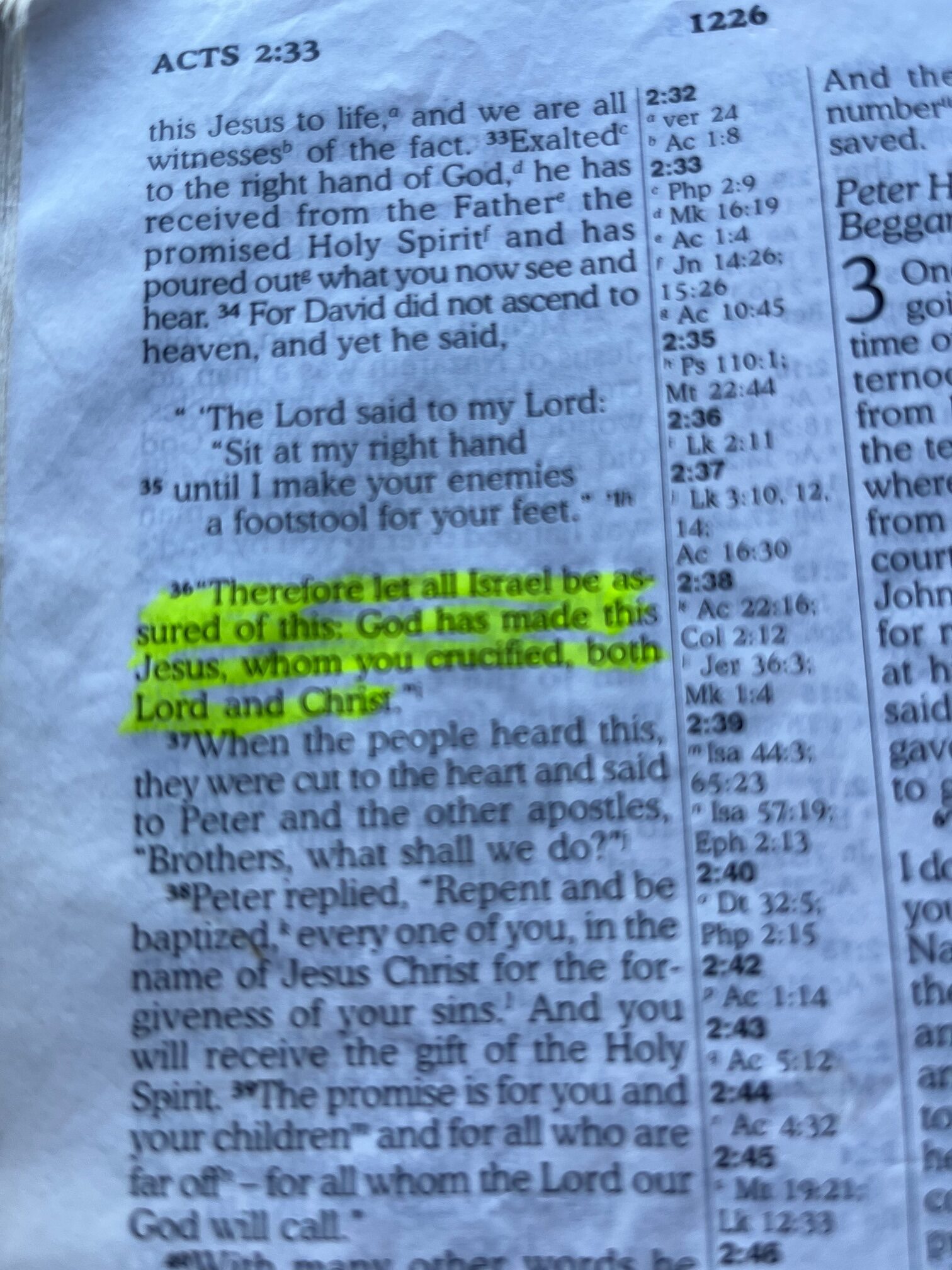
Peter in his Pentecost Sermon comes to the conclusion, “Therefore, God has made him both Lord and Christ, this Jesus whom you crucified.”[3] What does he mean that God has madehim “Lord?” Jews called God “the Lord”; is this what he means—Jesus is the Lord God Almighty? Throughout Acts “Lord” is used for Jesus and God, often in ways that make it difficult to know whom Luke means. This cannot be accidental. Luke certainly knew Jesus to be God Almighty.[4] But, if this is his meaning in the Pentecost Sermon, why does he say God has made him Lord?
Peter also quotes Psalm 110, the same psalm Jesus used to challenge the Jews to ponder who the Messiah might be. “The Lord said to my lord, ‘sit at my right hand until I make your enemies a footstool for your feet.’” Who is he, if David calls him Lord?[5] Jesus leaves the question hanging for us to answer. We want to affirm that Jesus is God, and yet the fact that God speaks to David’s Lord, and Peter’s conclusion that God has made him Lord and Christ do not allow us to do this easily.
It appears that Jesus should be seen as Lord in two different ways. He is the Lord God Almighty, maker of heaven and earth, but God has appointed (made) him the human king (lord) of his creation. Since Adam, there has been an expectation that God would one day rule the world through an anointed human being. This is an essential element in Israel’s hope for the kingdom of God. It is not about God ruling us only, but about his ruling us through a man. As the divine Son of God, and second member of the Holy Trinity, “for us men and our salvation he came down from heaven.” God sent him into the world to take on human nature and to establish his long-expected kingdom. By virtue of his incarnation, circumcision, baptism, life, sufferings, death, resurrection, and ascension he is Lord of the World, indeed of all Creation—“in heaven, and on earth, and under the earth.” This is the way we should interpret such Scriptures as:
“A Saviour who is Christ, the Lord.”[6]
“God has made him both Lord and Christ …”[7]
“… Jesus Christ, he is Lord of all …”[8]
“… set apart for the gospel of God, which he promised beforehand through his prophets in the holy Scriptures, concerning his Son, who was descended from David according to the flesh and was declared to be the Son of God in power according to the Spirit of holiness by his resurrection from the dead, Jesus Christ our Lord …”[9]
“God … has given him the Name which is above every name that at the name of Jesus every knee should bow, in heaven and on earth and under the earth, and every tongue confess that Jesus Christ is Lord to the glory of God the Father.”[10]
As to his identity he is none other than God himself, Yahweh, the Lord God Almighty, maker of heaven and earth; as to his office he is the human Lord of God’s creation and humanity.
How would this have worked out in actual ministry?
Think about the story of Paul and Silas in prison in Philippi. The jailer had a rough idea of why he was looking after these two Jewish prisoners; he would have entered their crimes in his logbook when he checked them in. It was something about “the Most High God” being the way of salvation: the clairvoyant girl who prophesied these things was probably known to the jailer. A public slave in a Roman colony, he lived in a world of many gods, and probably had his favourite, his “Lord.” Of course, he would not dispute anyone else’s right to worship a different lord; to his mind they could all be real enough.
So, when at midnight the jailer’s world was rocked by an earthquake and the only things that seemed not to be moving were Paul and Barnabas, he cried out, “Sirs, what must I do to be saved?” Paul answered him, not, “Believe in the Lord Jesus Christ.” “Christ” would mean nothing to a raw pagan. It sounded like “ointement.” No, Paul says, “believe in the Lord Jesus, and you will be saved—you and your family.” And he would know that in coming to put his trust in Jesus as Lord, he was acknowledging him as his God, indeed the one and only true God. Also, in confessing Jesus as Lord, he was declaring a human being, albeit a resurrected and ascended one, to be the one and only God. This may not have seemed as shocking to him as it was to the Jews, and as it is to Muslims today. Certain men like Augustus Caesar had become gods.[11]
So, it not only boils down to who is the true God, but also to who is the ruler of the world? And then we must add that God has given proof of this to all people by raising him from the dead. It is the resurrection of Jesus in history which moves the whole thing from the realm of worshipping whichever god pleases you, to the position of certainty. God is real. He has made himself known—through Jesus, and primarily by raising him from the dead. This is the cutting edge of Acts. The risen ascended Jesus is the man whom God has chosen to be the human head of the world, now and in the future. That must be the thrust of our message to the world. The meaning of life is not fully disclosed to us, but what is, is that God is placing everything under the feet of the Lord Jesus, and he will return to rule forever.
Recently, my wife and I led a service in the little chapel at Rottnest Island, and were disturbed to see that the island has become almost a shrine to Aboriginal spirituality. Throughout the Voice debate we heard nothing of the existence of Aboriginal Christianity. I suspect had we tried to protest we would quickly have been cancelled. It makes me think it is our Aboriginal Christian brothers and sisters who may have the hardest time of it in our new Australia, if they want to exempt themselves from the current revival of Aboriginal spiritism and confess Jesus as Lord. But all of us should make no mistake that any talk of Jesus outside of the church walls will not be welcomed. Nevertheless, we must make every effort to break through that barrier of silence. Perhaps one thing we might do is add a “Welcome to Country” to the beginning of our services. “I welcome you all in the Name of our Lord Jesus Christ.” Most services we attended in Africa started this way.. Jesus welcomes us into his presence—the Jesus who made and maintains our world and who gives to everyone life and breath and everything good. The Rev’d Neville Naden has written a Christian “Welcome to Country” for BCA’s indigenous resources, but ministers could craft their own. “All people that on earth do dwell,” coould be an appropriate opening hymn, or we could make use of the General Thanksgiving.
[1] The universe is composed of atoms in motion, which boils down to chance, though Epicurus taught that atoms swerved, which allowed for freewill.
[2] Acts 17.
[3] Acts 2.
[4] In his sermon Peter quotes from Joel 3, in which it says, “Whoever calls on the name of the Lord will be saved.” The Lord is Yahweh, but throughout Acts we see people calling on the name of the Lord Jesus.
[5] Mark 12.35–37.
[6] Luke 2.11.
[7] Mark 12.35–37; Acts 2.34–36; Psalm 110.
[8] Acts 10.36.
[9] Romans 1.2–4.
[10] Philippians 2.9–11. Compare Isaiah 45.22–23. The one and only God declares that all the earth will bow to him and confess his name (Yahweh).
[11] People had sworn they had observed his spirit ascend to the gods when he died. That was enough to declare his genius divine, and temples sprang up all over the empire to offer him worship. One thing an official like the jailer would be quick to do on appropriate occasions, if he valued his life was to confess, “Caesar is Lord.” Happily, Jews were exempted from that sort of thing. Julius Caesar had given them special dispensation; everyone knew they were weird.